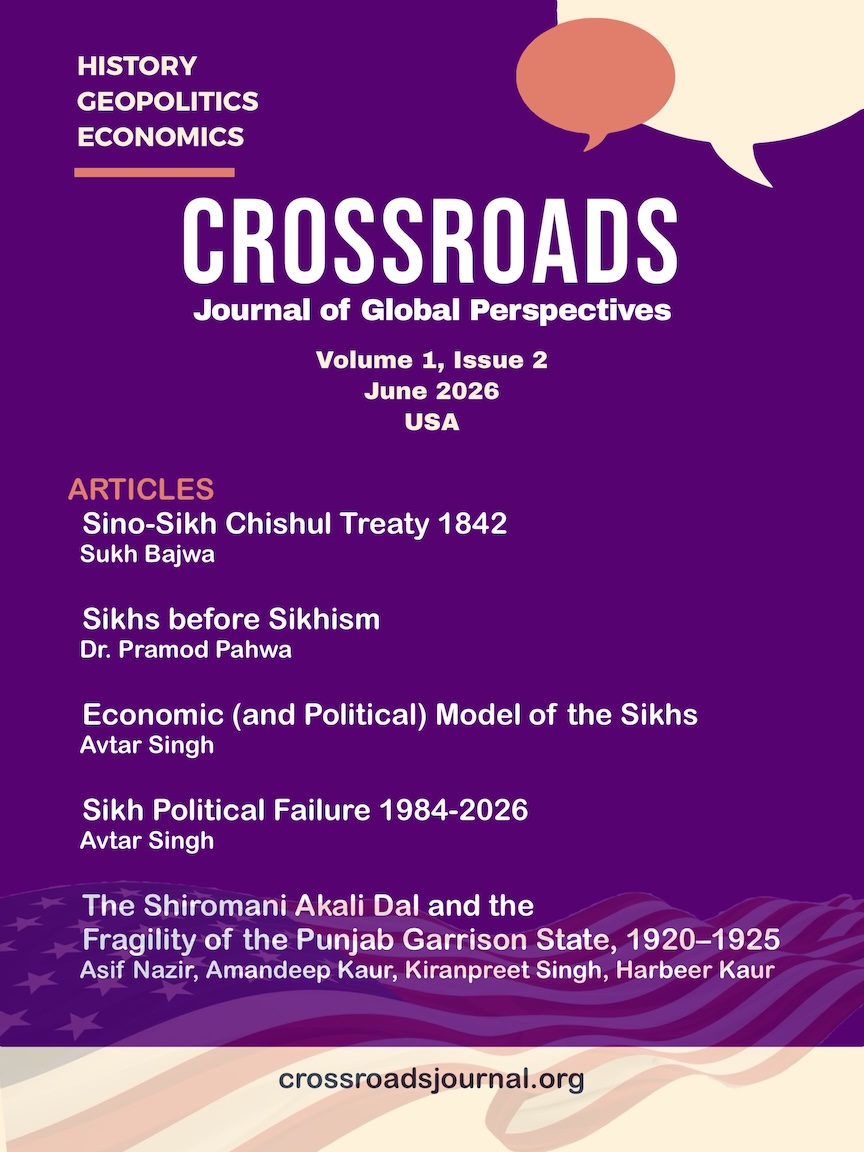
Shiromani Akali Dal and the Fragility of Governance in British Punjab, 1920–1925
DOI:
https://doi.org/10.67729/spwzzr84Keywords:
Shiromani Akali Dal, collaborative captivity, garrison state, Sikh Gurdwaras Act, colonial governance, Punjab, legislative fragmentation, non-violent resistanceAbstract
This paper argues that the emergence of the Shiromani Akali Dal (SAD) in 1920 exposed the fundamental flaws in British colonial rule in Punjab and constituted a serious structural challenge to the British government. This study offers a novel theoretical framework based on three new concepts: collaborative captivity, the judicial-proprietary paradox, and legislative fragmentation. Current historiography, however, concentrates on either the efficacy of Sikh mobilization or the strategic skill of British officials. In addition to opposing colonial authority, the study demonstrates how the SAD systematically undermined the state's alliances by taking advantage of the traditional Sikh identity that the British had created for military recruitment. The study demonstrates how the SAD changed military sociology from a pillar of colonial power into a channel of imperial weakness, building on Oberoi's important analysis of colonial Sikh identity formation and Fox's cultural materialist perspective on Akali mobilization. The Sikh Gurdwara Act of 1925 is reinterpreted as a tactical tool of legislative division, allowing a fundamentally weak colonial state to survive by channeling religious independence into manageable institutional structures, rather than as a generous reform or a definitive nationalist victory. The paper advances the theoretical conversation on movement institutionalization, colonial knowledge creation, and the relationship between legal frameworks and political legitimacy by offering new perspectives on how anti-colonial movements might take advantage of the internal conflicts of garrison states.
References
Abbas, N., & Ali, W. (2022). Shiromani Akali Dal (SAD) and politics of non-violence: A perspective of passive resilience, 1920–1930. Annals of Human and Social Sciences, 3(2), 383–391. DOI: https://doi.org/10.35484/ahss.2022(3-II)36
Blissett, A. (2023). The paladins of Punjab: A history of the Board of Administration, 1849–1853 (Doctoral dissertation, University of Oxford). Oxford University Research Archive.
Chatterjee, C. (2019). The Sikh minority and the partition of the Punjab, 1920–1947. Routledge. DOI: https://doi.org/10.4324/9780429024795
Chenoweth, E., & Stephan, M. J. (2011). Why civil resistance works: The strategic logic of nonviolent conflict. Columbia University Press.
Cohn, B. S. (1996). Colonialism and its forms of knowledge: The British in India. Princeton University Press. DOI: https://doi.org/10.1515/9781400844326
Condos, M. (2017). The insecurity state: Punjab and the making of colonial power in British India. Cambridge University Press. DOI: https://doi.org/10.1017/9781108289740
Fox, R. G. (1985). Lions of the Punjab: Culture in the making. University of California Press. DOI: https://doi.org/10.1525/9780520408654
Grewal, J. S. (1990). The Sikhs of the Punjab. Cambridge University Press. DOI: https://doi.org/10.1017/CHOL9780521268844
Kaur, H., & Gurna, R. S. (2025). Why and how did the Shiromani Gurdwara Parbandhak Committee come into existence? Remarking an Analisation, 10(5), 1069–1075.
Liebau, H. (2017). Martial races, theory of. In U. Daniel, P. Gatrell, O. Janz, H. Jones, J. Keene, A. Kramer, & B. Nasson (Eds.), 1914–1918 Online: International Encyclopaedia of the First World War. Freie Universität Berlin.
McCarthy, J. D., & Zald, M. N. (1977). Resource mobilization and social movements: A partial theory. American Journal of Sociology, 82(6), 1212–1241. DOI: https://doi.org/10.1086/226464
Oberoi, H. (1994). The construction of religious boundaries: Culture, identity, and diversity in the Sikh tradition. University of Chicago Press.
Panesar, A. S. (2016). Martialing the Sikh soldier during the First World War (Master’s thesis, University of Huddersfield). University of Huddersfield Repository.
Raj, A. R. (2024). A historical analysis of the trends in Punjab politics before the Second World War (1900–1940). Anthology The Research, 9(9), 3–23.
Riat, P. K. (2013). A historical and theological evaluation of the Sikh Gurdwaras Act, 1925 (Doctoral dissertation, University of Birmingham). UBIRA eTheses.
Sandhu, Akhtar Hussain. 2014. Punjab: An Anatomy of Muslim-Sikh Politics. 1st ed. Lahore: Dogar Publishers.
Sarna, N. (2025, December 20). How Akali movement reclaimed Sikh shrines and fought for India’s freedom. The Week.
Sharp, G. (1973). The Politics of nonviolent action. Porter Sargent.
Singh, M. (1978). The Akali movement. Macmillan Company of India.
Yong, T. T. (2005). The garrison state: Military, government and society in colonial Punjab, 1849–1947. SAGE Publications.
Downloads
Published
Issue
Section
License
Copyright (c) 2026 Asif Nazir (Author)

This work is licensed under a Creative Commons Attribution 4.0 International License.